Alanya Castle
Historical Information:
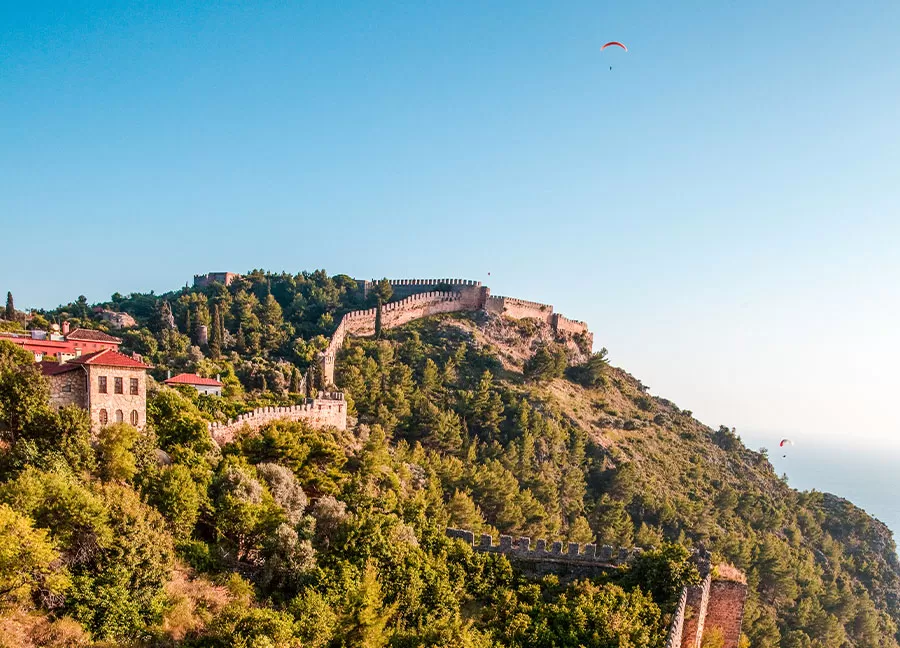
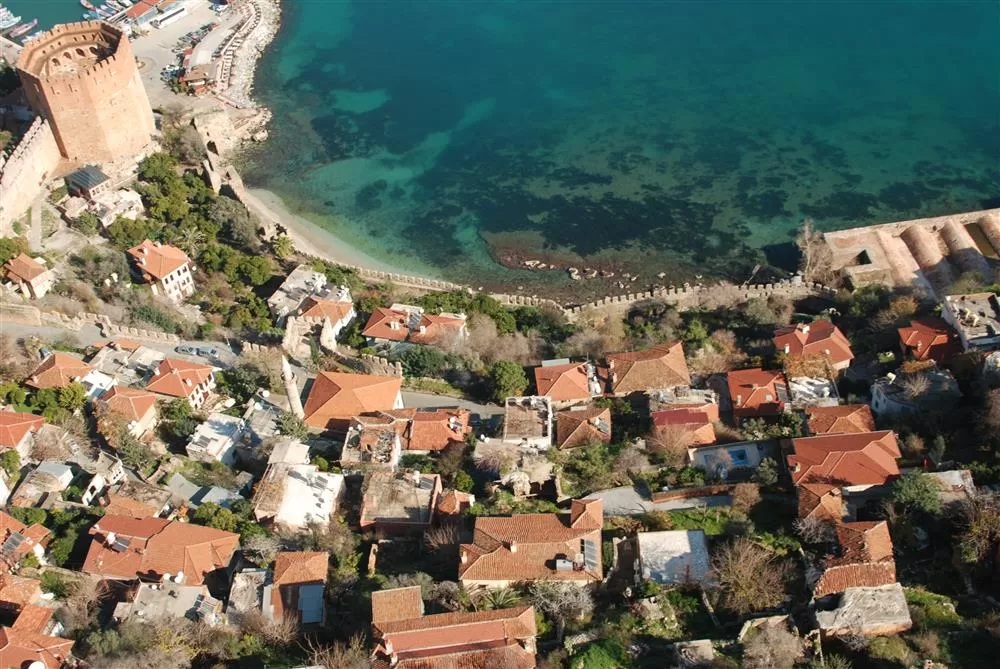
Surrounded by walls of 6 km length and situated on 10 hectares of the peninsula, The Castle of Alanya hosted Hellenistic, Roman, Byzantine, Seljuk and Ottoman civilizations.
The history of its establishment and by whom it was founded is unknown, but the geographer Scylax from 4th century BC mentioned Alanya as Coracesium at first. Strabon defined Coracesium as the first apparent city if travelled from west to Cilicia and specified its location as being on a very steep rock formation.
Coracesium, as a result of its defendable nature and its sheltered port, ideal for pirates and rebels, became a pirate harbour and a centre of piracy in 2nd century BC, even with the presence of a small military. The Hellenistic wall with a large block stone and mortar which spans from Arap Evliyası to Ehmedek, found in the part of Middle Castle (Orta Kale), dates back to the period of Diototos Tryhon, who was the ruler of the city in 2nd century BC.
In 65 BC, the pirate dominance ended with the Coracesium war, which resulted in the victory of the Roman Pompeius. The city in Roman times grew with the expansion of its walls and the addition of new buildings. In this period, coins were created in the name of the emperors. Samples of these coins can be seen in Alanya Museum.
With the name of Kalonoros (the beautiful mountain), Alanya Castle in Byzantine times became a locating point for sailors and the busiest port of the Mediterranean. The Church in the castle (İçkale), Arap Evliyası, ruins of the monastery at Cilvarda point and the remains of the round – towered wall which spans from the Middle Fortress (Orta Hisar) to the castle (İçkale), date back to the Byzantine period.
In 1221, Kalonoros was taken over by Alaeddin Keyqubad I, Anatolian Seljuk Sultan, from Kyr Vart, the former owner of the castle and its name was changed to Alaiye. Alaeddin Keyqubad I began various construction projects, reinforced old walls, built new walls and started the golden age of Alanya. Today’s existing walls, large cisterns, the shipyard, the Red Tower, the Cannon House, Akşebe tomb and the palace complex in the castle (İçkale) are some of the works built by Alaeddin. Ehmedek, Akşebe Small Mosque, Andızlı Mosque, the Seljuk Baths and the Lower Castle (Asagi Kale) Baths were constructed during the reign of the Seljuk’s.
By conquering Alanya, the Anatolian Seljuk Sultanate gained a strong castle in the coast of the Mediterranean as well as a strong foundation in both the sea and the land. Alaiye also reached a specific status in developing internal, external and transit trade.
Alaiye in the first half of the 14th century was among the most important cities of Anatolia and the Mediterranean. It had an important naval base, and it was a leading commercial city as well as a centre of trade and shipbuilding under the Anatolian Seljuks by having strong relations with Egypt and Syria. Egyptian merchants came looking for famous cedars used in the construction of ships, as well as, Genoese, Venetian and Florentine merchants who bought spices, canvas and sugar. Pegolotti in his book “practura della mercatura” introduced a table for weights and measurements used in Alanya, comparing them with the ones used in Italy. Egyptian and Syrian merchants were traveling to the Black Sea ports via Alanya.
Alaiye fell to the Kingdom of Cyprus for a short period of time after the collapse of the Seljuk Sultanate (1293) and then came under the dominance of the Ottomans after periods of Karaman and Alaiye principality rule (1471). Süleymaniye Mosque, covered market with the Ottoman bazaar at the Upper Castle (Yukari Kale) and the traditional Alanya houses are monuments of the Ottoman period.
Alaiye in the Republican period took its name at the request of Mustafa Kemal Atatürk, who visited the city.
Many local and foreign travellers talked about Alanya Castle. In 1332, Ibn-i Batuta stated export of timber to Alexandria, Damietta and Egyptian cities. In the 1650s, Katip Çelebi compared Alanya Castle with the Baghdad Castle with regard to its magnificence and noted the growing of cotton, silk and sesame. Also, in 1671 Evliya Çelebi stated that there were three hundreds houses, the Süleymaniye Mosque and the small Akşebe Mosque, a cistern and houses without patios at the Middle Fortress (Orta Hisar); two madrasas, six schools, three khans, one bath, one fountain and one hundred and fifty shops at the Lower Castle (Asagi Kale), noting that all streets had steps and access was provided by mules and donkeys.
Setton Llyod in his Ala’iyye book separated Alanya Castle into five (5) regions by the segmentation of its walls. The first region has the shape of a crescent, whose one end is the Red Tower and the other is the shipyard; second is the lower pitched part of the hill above the first region; third is the region of Ehmedek and the area that extends to the Inner Castle (İçkale); fourth region is the Inner Castle (İçkale) and the fifth region is the area that encompasses the Cilvarda Point.
How Can I Go?:
Public Transportation:
There is a minibus stop on the seaside of the main road. An Alanya bus passes every 10 minutes. You can get off at the last stop or ask the minibus driver to drop you off at the closest point to your destination.
Extra Information:
It is possible to use the cable car for Alanya Castle. For price and detailed information, you can visit the website of ALANYA TELEFERİK A.Ş. The cable car operates from 09:30 to 23:00

Red Tower
Historical Information:
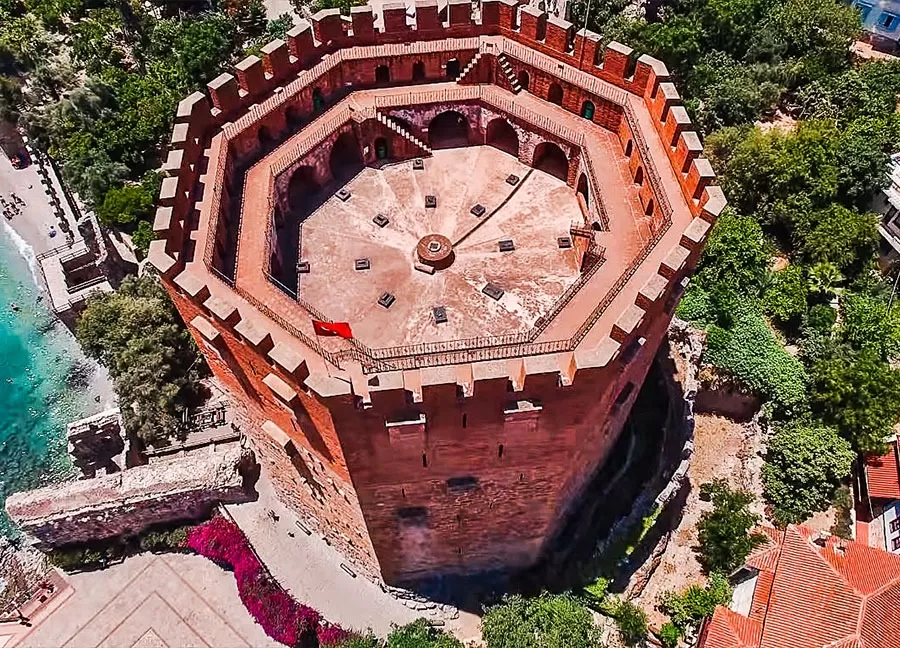
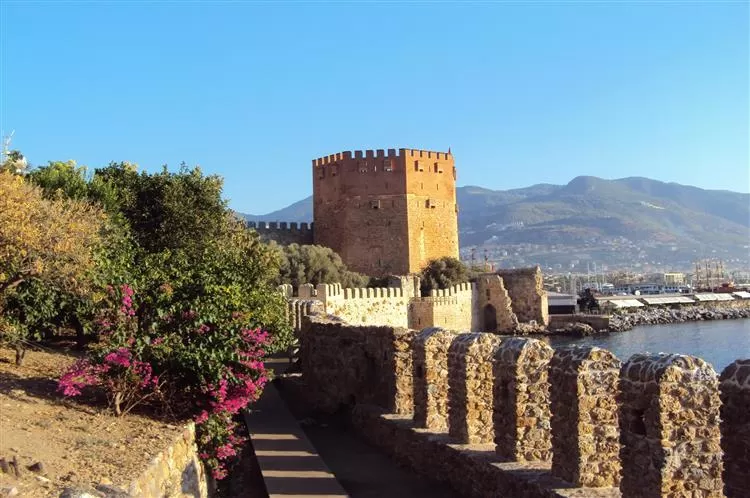
Being one of the most unique examples of medieval Mediterranean defense structures from the 13th century, Red Tower was built by the order of Alaeddin Keyqubad I, the Seljuk ruler, given to Ebu Ali Reha el Kettani, who was a master builder from Aleppo, in order to protect the harbour, the shipyard and Alanya Castle against attacks from the sea.
The Red Tower has, and still does, attract attention with its breathtaking views and as such it has been the subject of many books. Evliya Celebi, a 17th century traveller, stated that “there is a solid octagonal tower at the seaside of the Castle of Alanya. This tower can hold two thousand (2000) men during a siege and the second gateman who lives in here has forty (40) soldiers”.
Due to having been built on a bedrock with a sloping ground, the structure is 33 meters tall at its east, but 3 meters shorter at its west. At the bottom main walls, rectangular limestones, uniformly cut and stuck together, and classic shafts were used. At the upper sections meanwhile, red bricks were used.
There is a writing that says “Gratitude to Allah” on the north wall of the structure, and below it there is a four-line inscription which is 10 meters up from the ground, written on the behalf of Alaeddin Keyqubad, which states the construction’s starting date as April 1226. There is also another writing on the south wall related to the construction. A construction inscription on the right wall of the entrance which states the name of the master who built the structure is also present. There are a total of fifty-six (56) crenel windows at the facades of the Red Tower, while there are twenty-two (22) spans for pouring hot pitch and water and six (6) gargoyles inline to repel and to make it impossible to escape.
With its octagonal plan, the Red Tower has a complex interior plan, contrary to its exterior view. The Red Tower has five floors: The ground and the first floors, the entresol, the open floor and the open terrace.
In opposition to the monumental appearance of the structure, the ground floor can be reached by a small and simple entrance and a narrow corridor, probably due to military purposes. The octagonal pillar in the centre is surrounded by a vaulted corridor. According to Ibrahim Hakkı Konyalı, during the early days of the structure, at the ground and first floors, there were lowered rooms made from wood, which extended from the beginning of the corridor vault to the upper cover, used by the guards to rest. Today, the ground floor is used as an exhibition area.
Reached by high, stone steps; a large cistern is placed on the upper part of the foot in the centre of the 1st floor. Even today, it is still functioning. The mouth of the cistern is found at the open floor.
On the floor of the corridor close to the cistern, a ventilation shaft each was placed in the centre of the octagonal sides. The door at the northwestern side of the structure, which is at the floor used as an exhibition area, opens to the exterior walls. A big ship graffiti can be seen on the right wall.
There are spans for pouring hot pitch and water at the entresol that is shaped like a narrow corridor.
There are a total of sixteen (16) air shafts placed in two rows at the mouth and at the surroundings of the cistern in the centre of the open terrace. Light can enter from these shafts and reach the first floor.
How Can I Go?:
Public Transportation:
There is a minibus stop on the seaside of the main road. An Alanya bus passes every 10 minutes. You can get off at the last stop or ask the minibus driver to drop you off at the closest point to your destination.
Extra Information:
Harbor Walls
Historical Information:
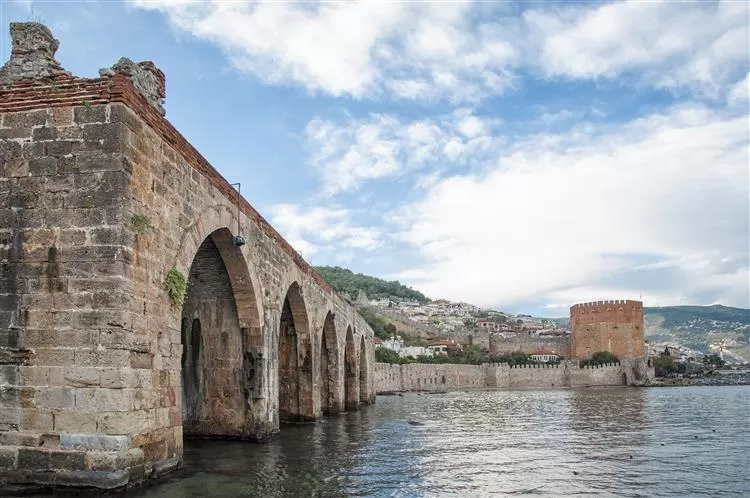
Built in period of Alaeddin Keyqubad I, harbor walls form its gorgeous profile by its monumental structures such as Red Tower, shipyard and cannon house and harbor region of Alanya Castle from the sea side. As a port city, since ancient times and especially its hey-days in the Middle Ages, Alanya was considered among busy ports of the eastern Mediterranean basin and hosted merchants of Egypt, Genoese and Venetian. Hundreds of ship graffiti from different eras, which can be seen on walls of various buildings of Alanya Castle, witness connection of Alanya with its sea.
How Can I Go?:
Public Transportation:
There is a minibus stop on the seaside of the main road. An Alanya bus passes every 10 minutes. You can get off at the last stop or ask the minibus driver to drop you off at the closest point to your destination.
Extra Information:
Shipyard
Historical Information:
Five – line relief inscription above narrow entrance of the structure, which entered by old harbor on north – west directions, draws the attention. In first line of the inscription, which Alaeddin I was praised as the sultan of the two lands and seas, heraldry in the middle of two rosettes can be seen. While a space with five windows on left of the entrance was used as a small mosque, right was used as an office by shipyard officers. During the work of conservation – restoration within Maritime and Ship Museum project in space of the small mosque, Zulfikar frescoes, symbolizing the justice of Hz. Ali, was uncovered on two opposing walls.
The structure of shipyard consists of five (5) vaulted division and walls with pointed arch, which separate eyes. Its walls made of ashlars and its arches and vaults from brick, ventilation flaps on vaults of the shipyard provides both entering light inside and going smoke outside. A well is found in third division of land side. The structure was built in different levels to hold less for rock fracture. A depot, which carved into the rock, has light through a hole.
Alanya shipyard is a permanent structure, which is not only a shipbuilding or stopover place in winter but also making repair, vessels and ship equipments and having iron atelier, administrative and depot areas. Permanent structures serve for two purposes. The first is to arrange the construction of big ships during winter and second is to hold unused vessels. Enemy navies or pirates were looking for strategical locations to provide big merchant benefits. Alanya had this situation and shipyard as being a part of a complex with two towers in walls, which ensured an appropriate position to protect from enemy attacks. Kitab-ı Bahriye of Piri Reis was determined that the shipyard was supervised by a Commander of Navy Force in permanent, activities of shipyard continued in period of Karamanoğulları and Alaiye Beyliks after Seljuk and ships were built during Ottoman time.
The shipyard, which shipbuilding and repair continued until years of 1960s, serves as a museum for maritime and ship in present.
How Can I Go?:
Public Transportation:
There is a minibus stop on the seaside of the main road. An Alanya bus passes every 10 minutes. You can get off at the last stop or ask the minibus driver to drop you off at the closest point to your destination.
Extra Information:
Tophane Neighborhood
Historical Information:
Tophane Neighborhood has a fascinating feature by its traditional street fabric with recently restorated traditional Alanya houses. All of these houses, built on quite sloping ground, face to the sea. Each house has its own cistern due to lack of natural water. In the 1600s, Evliya Çelebi stated that access was provided by mules; Martin Leake wrote that he was very surprised by expertly built houses in 1810, houses in Alanya rose as a shape of terrace with back to back, by this rise houses were seemed like overlapping when looked from the counter and flat roof of some part of houses in same line served as door in front and a small street for upper houses.
At the Tophane Neighborhood, presenting the profile of a daily life for Alanya with its old traditional houses and 13th century small mosque, Andızlı and Wooden Minaret Mosques, Hagios Constantinous and Mikail Archengelos Churches as well as an old fisherman’s house which is converted to a boutique hotel after its restoration, gourd crafts workshop unique to Alanya, its friendly people with its sea view, you can also see endemic plant and butterfly species distinctive to Alanya.
How Can I Go?:
Public Transportation:
There is a minibus stop on the seaside of the main road. An Alanya bus passes every 10 minutes. You can get off at the last stop or ask the minibus driver to drop you off at the closest point to your destination.
Extra Information:
Damlataş Cave
Historical Information:
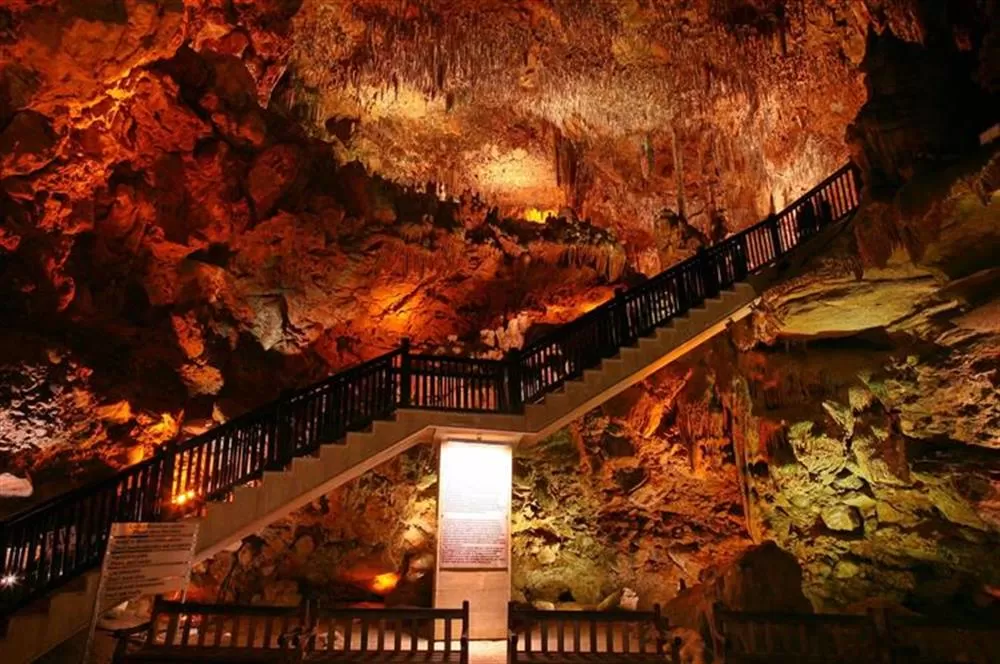
Damlataş Cave was found in 1948 when it was opened for stone pit during construction of port. Cave is on the west coast of the historical Alanya Castle. There is a 50 m at entrance of the cave. You can come to a cylindrical space after the gateway with 15 meters . After here, you can walk into the bottom of cave. Name of Cave “Damlataş” comes from the stalactite which exists by water droplets. Except of its beauty, this cave is popular because of its atmosphere helping people who have asthma illness. These people who come by doctor’s control stays in the cave for 21 days as cure. Weather of the cave doesn’t change during seasons, temperature is 22 C0, damp is %95, constant pressure is 760mm. In the weather of cave there are %71 nitrogen, % 20,5 oxygen, 2,5/10.000 (two and half to ten thousands) CO2 and some radioactive ion.
It is the first cave which was opened to tourism in Turkey.
How Can I Go?:
Public Transportation:
There is a minibus stop on the seaside of the main road. An Alanya bus passes every 10 minutes. You can get off at the last stop or ask the minibus driver to drop you off at the closest point to your destination.
Extra Information:
Dim Mağarası
Historical Information:
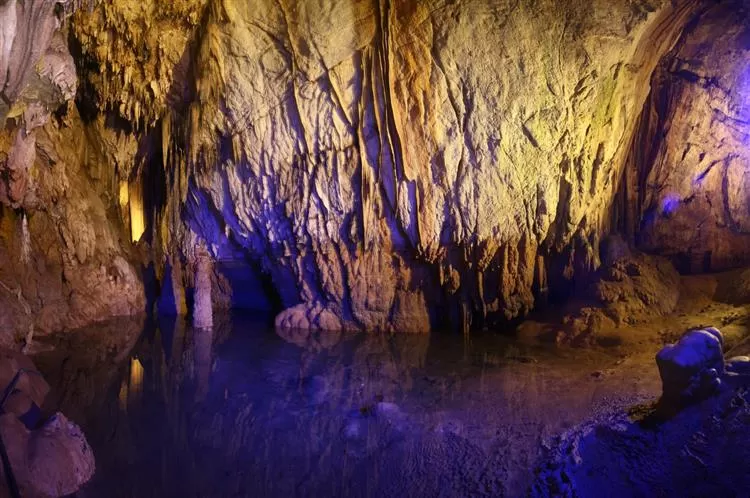
Ceiling of the cave is about 78 m height. In old times, it is known that the cave was used as booty storage by pirates and keeping the girls who were kidnapped. According to rumour, it was said that cave had a connection way through the castle, reached the kidnapped girls and booties, then fallen down and closed after the years of hundreds and thousands.
Now you can go into the cave by boats.
How Can I Go?:
Public Transportation:
There is a minibus stop on the seaside of the main road. An Alanya bus passes every 10 minutes. You can get off at the last stop or ask the minibus driver to drop you off at the closest point to your destination.
Extra Information:
Incekum Beach
Historical Information:
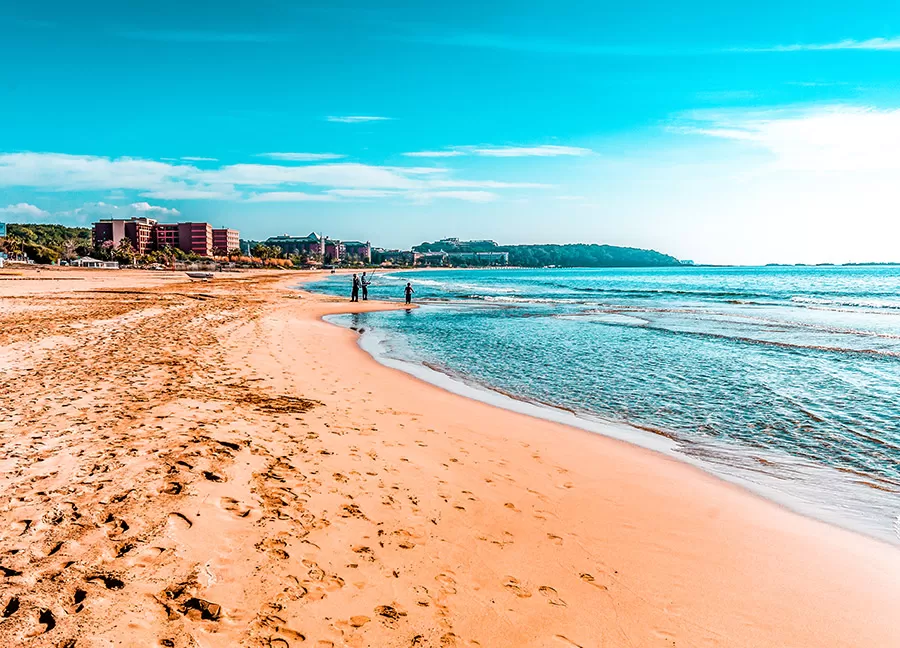
It is near the Avsallar Town that is on the 26th km of road between Alanya and Antalya. It has an important point for Alanya because of being sea and forest together. It is very attractive place for its clear and shallow sea, thin sand, and picnic areas for people.
How Can I Go?:
Extra Information:
Public Transportation:
You can wait for the bus under the overpass on the hotel side of the main road. A bus passes every 10 minutes. You can ask the bus driver to drop you off at the closest point to your destination.
Damlatas Beach
Historical Information:
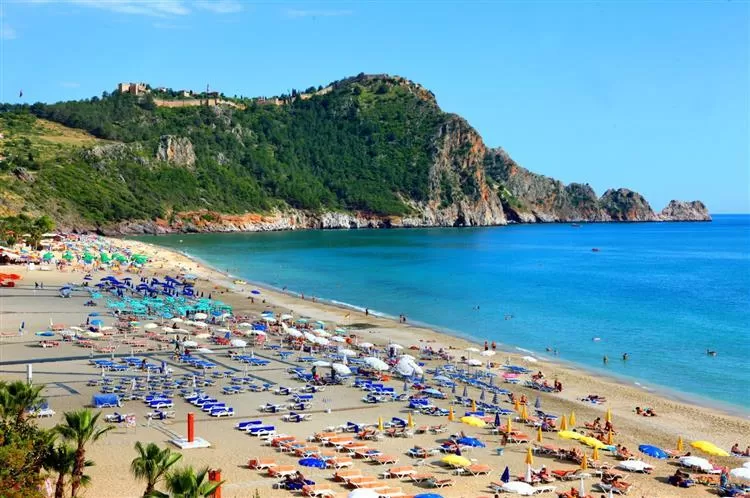
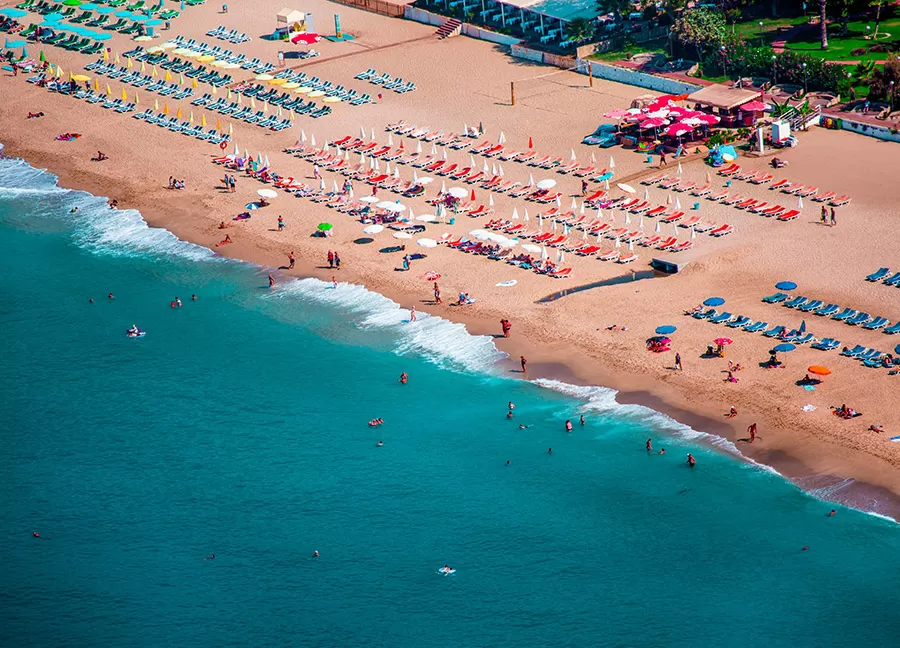
It is in front of the Damlatas Cave, on the boom of Alanya Castle. In front of the park and Damlatas Cave each kind of service can be provided. Alanya Beach has glamorous beauty with clear and thin sand. Behind of this beach there are many hotels which service to tourism. Cleopatra Beach that is behind of Castle has clear and thick sand and also becomes deep from seafront. Sandy beach is quite wide.
How Can I Go?:
Public Transportation:
There is a minibus stop on the seaside of the main road. An Alanya bus passes every 10 minutes. You can get off at the last stop or ask the minibus driver to drop you off at the closest point to your destination.
Extra Information:
Cleopatra Beach
Historical Information:
It is on the west side of the historical peninsula and on the seafront of the Damlatas Cave. It has blue flag. Backside of beach is on the seafront of peninsula. This natural beach that is covered by rocks, it is famous with the story of Egypt Queen Cleopatra and Roman Emperor Antonius swam in here. Small cove that is known as Cleopatra that lies through the peninsula and existed with big stones. Its clarity is quality of this beach. When you swim underwater, you can see fishes and other natural beauties. You can go into the beach freely, but services on the beach has cost.
How Can I Go?:
Public Transportation:
There is a minibus stop on the seaside of the main road. An Alanya bus passes every 10 minutes. You can get off at the last stop or ask the minibus driver to drop you off at the closest point to your destination.
Extra Information:
Alanya Archaeology Museum
Historical Information:
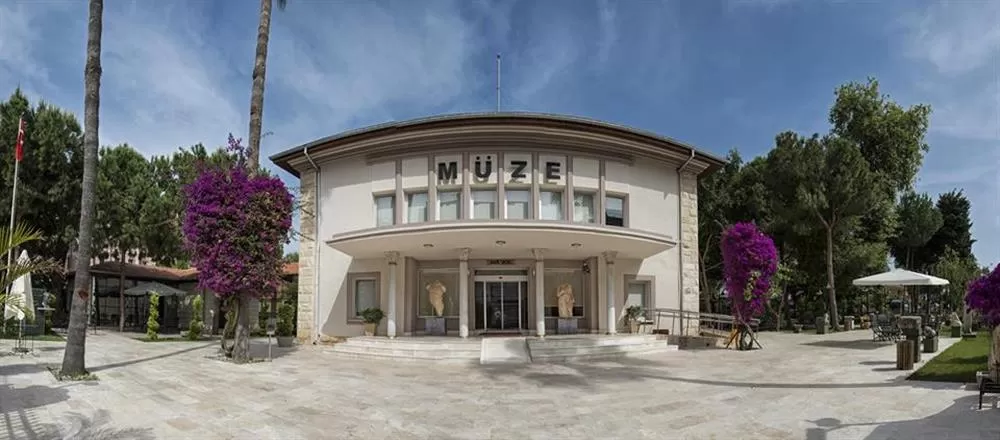
Museum, which has 14 closed and 1 open exhibition saloons, was opened in 1967 with objects that belongs Bronze Age, Urartin, Phrygian, Lydia which were taken from Ankara Anatolian Civilization Museum. The most important object in museum is bronze “Hercules” statue that has the dramatically story in 2nd century AD and exhibited in a different saloon. There are antiques of bronze, marble, earthenware, glass and mosaic with rich ostotek (ash urn) and coin collection from periods of Archaic, Classic, Hellenistic, Roman, Bizantium in the museum. Turkish – Islamic monuments belonging to Seljuk and Ottoman Periods reserve an important place.
How Can I Go?:
Public Transportation:
There is a minibus stop on the seaside of the main road. An Alanya bus passes every 10 minutes. You can get off at the last stop or ask the minibus driver to drop you off at the closest point to your destination.
Extra Information:
Atatürk House And Museum
Historical Information:
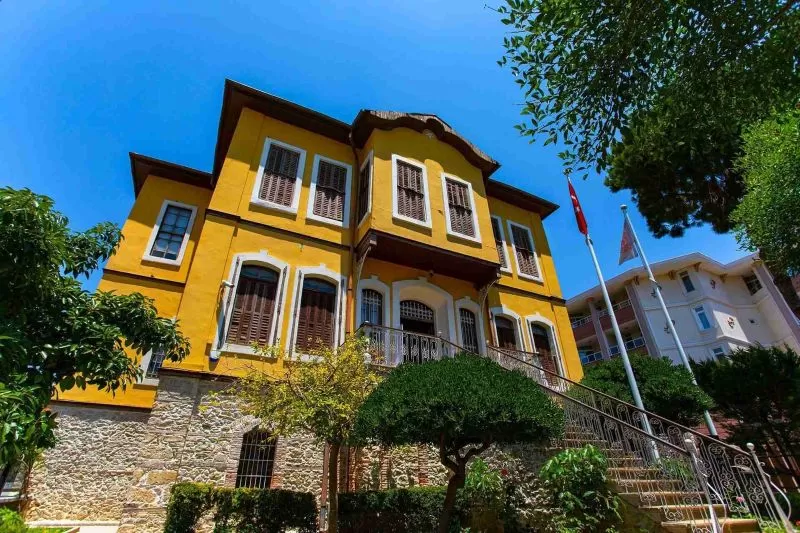
It is unknown certainly about the date of building history which is estimated that belongs to the term of II. Constitutional Period. When Atatürk visited Alanya in 18th February 1935, he stayed in this house which was donated to Ministry of Culture and Tourism by owner of house, Rıfat Azakoğlu.
How Can I Go?:
Public Transportation:
There is a minibus stop on the seaside of the main road. An Alanya bus passes every 10 minutes. You can get off at the last stop or ask the minibus driver to drop you off at the closest point to your destination.
Extra Information:
Dim River
Historical Information:
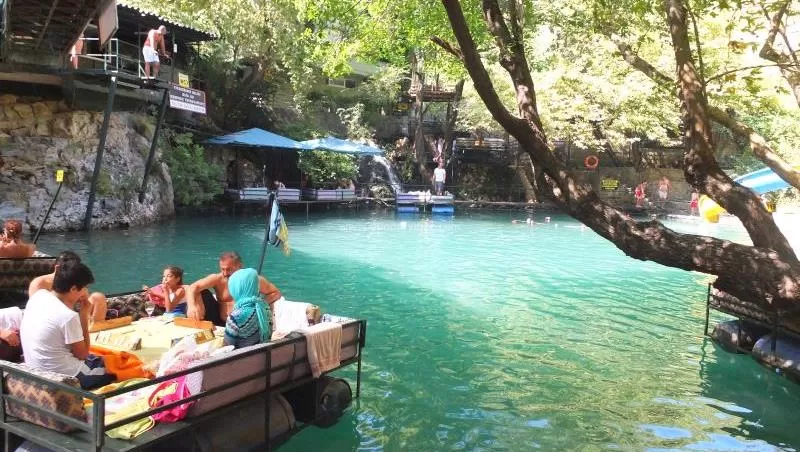
Dim River is one of the most popular natural attractions in Alanya. Located about 15 km from the city center, it offers a cool escape from the heat with its refreshing water and beautiful scenery. Along the river, you’ll find riverside restaurants with seating areas over the water, where you can enjoy fresh fish and traditional Turkish food. It’s also a great spot for picnics, swimming, and relaxing in nature. Perfect for a peaceful day out!
How Can I Go?:
Public Transportation:
There is a minibus stop on the seaside of the main road. An Alanya bus passes every 10 minutes. You can get off at the last stop or ask the minibus driver to drop you off at the closest point to your destination.
Extra Information: